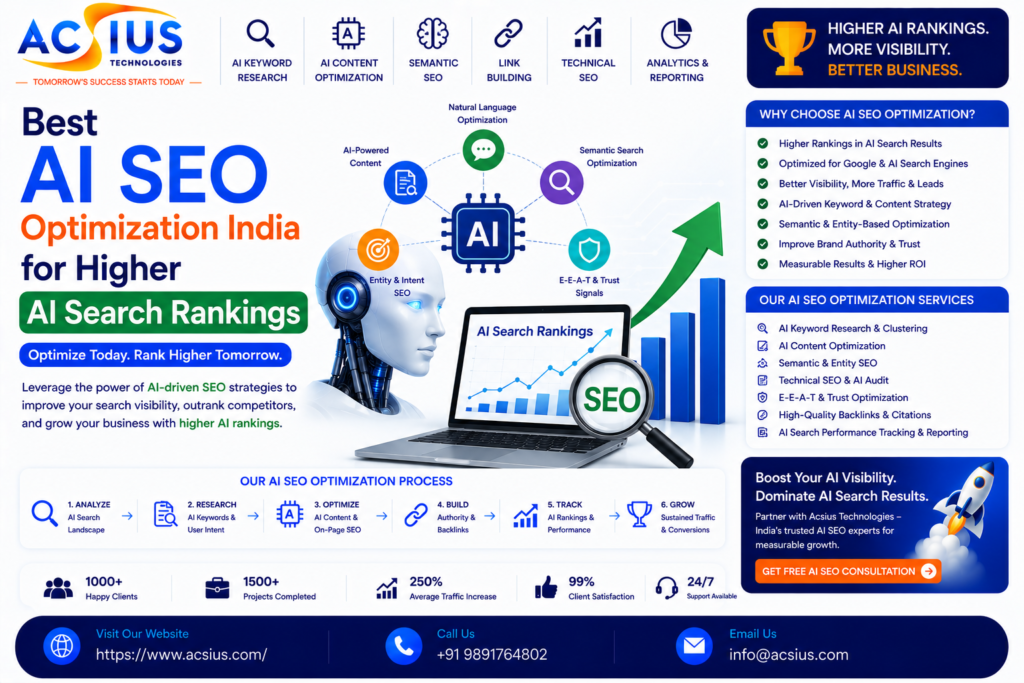
The way people search for information has changed forever. Instead of typing a query into Google and scrolling through ten blue links, users now ask questions directly to AI-powered search experiences like Google’s AI Overviews, ChatGPT, Perplexity, and Bing Copilot — and expect a single, accurate answer instantly. For businesses in India, this shift means that traditional SEO alone is no longer enough. Brands need a strategy built specifically for how AI models crawl, understand, and cite content.
This is exactly where AI SEO comes in. It is not just an evolution of old-school keyword optimization — it is a completely new discipline that blends structured data, semantic content, entity authority, and answer-first writing to help a brand appear inside AI-generated answers rather than just on a search results page. Indian businesses that want to stay visible in this new era need to rethink how their websites are built, written, and optimized from the ground up.
If you’re looking to future-proof your visibility, working with a specialist in AI SEO Optimization India is the smartest first step. Alongside this, brands are increasingly investing in AEO Services in India to make sure their content gets picked up as a direct answer by AI engines, while still relying on a trusted SEO Company India to handle the technical and on-page foundations that both traditional and AI search depend on.
Why AI Search Rankings Matter More Than Ever in 2026
Search behavior in India has shifted dramatically over the past two years. Millions of users now rely on conversational AI tools for everything from product research to local business recommendations. Google’s AI Overviews appear at the top of a large share of search results, often answering the user’s question before they even click a single link. This means that ranking on page one is no longer the finish line — being the source an AI model chooses to quote or summarize is the new goal.
For businesses, this creates both a challenge and an opportunity. The challenge is that fewer users are clicking through to websites when an AI answer already satisfies their query. The opportunity is that brands who structure their content correctly can become the trusted source that AI engines pull information from, gaining visibility, credibility, and traffic that competitors miss entirely. Companies that ignore this shift risk becoming invisible in the exact channels where their future customers are searching.
What Exactly Is AI SEO Optimization?
AI SEO optimization is the practice of structuring, writing, and technically preparing a website so that AI models and large language models can easily crawl, interpret, and reference its content. Unlike traditional SEO, which focuses heavily on keyword density and backlinks, AI SEO focuses on:
- Semantic clarity — writing content in a way that clearly answers a specific question or intent, rather than just targeting a keyword.
- Structured data and schema markup — helping AI crawlers understand what a page is about, who wrote it, and how trustworthy the source is.
- Entity-based authority — building a recognizable brand entity across the web so AI models associate your business with expertise in a specific topic.
- Content depth and originality — AI models favor content that provides unique insights, data, or perspectives rather than rehashed information already available elsewhere.
- Fast, crawlable technical architecture — a website that loads quickly and is easy for both traditional bots and AI crawlers to access and index.
When these elements come together, a website becomes far more likely to be cited, summarized, or recommended by AI search tools — which is the ultimate goal of modern SEO.
Key Components of a Winning AI SEO Strategy in India
-
Answer-First Content Structure
AI search engines prefer content that gets to the point quickly. Instead of long introductions before answering a question, top-performing pages now open with a direct, concise answer in the first few lines, followed by supporting detail, data, and context. This format mirrors how AI models themselves generate answers, making it easier for them to lift and cite your content.
-
Structured Data and Schema Markup
Implementing FAQ schema, How-To schema, Article schema, and Organization schema helps AI crawlers quickly identify the purpose and credibility of a page. This structured layer acts like a translation guide between your website and the algorithms trying to understand it.
-
Topical Authority Through Content Clusters
Rather than publishing isolated blog posts, successful brands build interconnected content clusters around a core topic. A central pillar page links out to detailed subtopic articles, and those articles link back to the pillar — signaling deep expertise to both traditional search engines and AI models.
-
E-E-A-T Signals (Experience, Expertise, Authority, Trust)
AI models are trained to prioritize trustworthy sources. This means author bios, verifiable credentials, case studies, testimonials, and transparent sourcing all play a growing role in whether your content gets selected as a citation.
-
Natural Language and Conversational Optimization
Since users now phrase search queries as full questions, content needs to be optimized for natural, conversational phrasing rather than short, robotic keyword strings. Writing in a way that mirrors how real people ask questions dramatically increases the chances of being matched to a voice or AI search query.
Understanding AEO: The Missing Piece Most Businesses Overlook
Answer Engine Optimization, or AEO, is a specialized subset of AI SEO focused entirely on getting your content selected as the direct answer within AI-generated responses. While traditional SEO aims to rank a page, AEO aims to become the answer itself — whether that appears in a Google AI Overview, a ChatGPT response, or a voice assistant’s spoken reply.
AEO relies heavily on structuring content into clear question-and-answer formats, using precise and concise language, and ensuring that each page targets a specific, well-defined query. It also depends on strong technical foundations like crawlability, page speed, and clean HTML structure, since AI crawlers need to access and parse content efficiently to extract accurate answers.
Businesses that invest early in AEO are positioning themselves ahead of competitors who are still focused purely on classic ranking metrics. As more search volume shifts toward zero-click, AI-generated answers, the brands that show up inside those answers will capture disproportionate visibility, trust, and eventual traffic — even if fewer users click through in the short term.
How to Choose the Right SEO Partner in India
With so many agencies claiming expertise in “AI SEO,” it’s important to know what actually separates a capable partner from one that’s simply repackaging old-school tactics under a new label. Here’s what to look for:
Proven understanding of AI search mechanics. Ask how they optimize for AI Overviews, LLM citations, and voice search specifically — not just traditional Google rankings.
Technical SEO depth. Core Web Vitals, crawl budget optimization, structured data implementation, and mobile performance all remain foundational, even in an AI-first world.
Content strategy built around intent, not just keywords. A capable partner should be mapping content to real user questions and search intent, not just stuffing keywords into paragraphs.
Transparent reporting. You should be able to see clear metrics on organic visibility, AI citation tracking, and traffic quality — not vague promises.
Industry experience. A partner who understands your specific industry can craft content and authority signals that resonate with both your audience and the AI models evaluating your expertise.
Long-term strategic thinking. AI search is evolving quickly. The right partner should be adapting strategies continuously rather than applying a one-size-fits-all playbook.
Proven Strategies to Improve Your AI Search Visibility
Optimize for Featured Snippets and AI Overviews
Structure your content with clear headers, bullet points, and concise answers positioned near the top of the page. This format is exactly what AI Overviews and featured snippets are designed to pull from.
Build a Strong Google Business Profile
For local businesses across India, an optimized Google Business Profile with accurate information, reviews, and regular updates significantly boosts visibility in local AI-driven search results and map packs.
Invest in High-Quality Backlinks
While AI models weigh content quality heavily, backlinks from reputable, relevant websites still signal authority and trustworthiness — both to traditional search algorithms and to AI systems trained on web-wide trust signals.
Publish Original Research and Data
AI models are trained to favor unique, verifiable information over generic content. Publishing original surveys, case studies, or industry data dramatically increases the odds of being cited as a primary source.
Keep Content Updated
Freshness matters. Regularly updating existing pages with new data, examples, and insights signals to both crawlers and AI models that your content remains current and reliable.
Optimize for Voice Search
With more Indian users relying on voice assistants in regional languages and English, optimizing for natural, spoken-language queries is becoming an essential part of any modern SEO strategy.
Common Mistakes Businesses Make With AI SEO
Many businesses assume that simply adding more keywords or publishing more blog posts will improve their AI search visibility. In reality, AI models penalize thin, repetitive, or overly promotional content. Other common mistakes include:
- Ignoring technical SEO fundamentals like site speed and mobile usability
- Failing to implement structured data and schema markup
- Writing content that answers questions vaguely instead of directly
- Neglecting author credibility and trust signals
- Treating AI SEO as a one-time project instead of an ongoing strategy
Avoiding these pitfalls requires a disciplined, data-driven approach — one that treats AI search optimization as a continuous process of refinement rather than a single campaign.
The Future of AI Search in India
India is one of the fastest-growing digital markets in the world, and AI-driven search adoption is accelerating quickly across both metro and tier-two cities. As more users shift toward conversational, AI-assisted search experiences, businesses that fail to adapt risk losing significant visibility to competitors who invest early in this space.
The businesses that will thrive over the next few years are the ones building strong topical authority now, structuring their content for both humans and machines, and treating AI search optimization as a core part of their digital strategy — not an afterthought. This means combining technical excellence, high-quality content, and a deep understanding of how AI models evaluate and select sources.
Final Thoughts
AI search is no longer a future trend — it’s the present reality shaping how millions of people in India discover businesses, compare products, and make decisions every single day. Brands that adapt their SEO strategy to this new landscape will capture visibility, trust, and traffic that competitors relying on outdated tactics simply cannot access.
Getting this right requires more than just following a checklist — it requires a partner who understands the technical, content, and authority-building layers that AI search rewards. That’s exactly the kind of specialized expertise ACSIUS brings to the table, helping Indian businesses build the structured, answer-first, technically sound foundations needed to rank higher in both traditional and AI-driven search results, and to stay ahead as search continues to evolve.
FAQs
Why do businesses in India need AI SEO now?
Indian users are increasingly relying on AI Overviews, chatbots, and voice assistants to find information and make decisions. Businesses that don't optimize for these AI-driven experiences risk losing visibility to competitors who do, even if they still rank well in classic search results.
What is AEO and how does it relate to AI SEO?
AEO, or Answer Engine Optimization, is a specialized part of AI SEO that focuses specifically on getting content selected as the direct answer inside AI-generated responses, voice assistants, and featured snippets, rather than simply improving a page's overall ranking position.
How long does it take to see results from AI SEO optimization?
Timelines vary depending on website authority, competition, and content quality, but most businesses begin seeing measurable improvements in visibility and AI citations within three to six months of consistent optimization.
Does AI SEO replace the need for traditional SEO?
No. Traditional SEO fundamentals like technical performance, backlinks, and on-page optimization remain essential. AI SEO builds on top of these fundamentals rather than replacing them.
What role does schema markup play in AI search rankings?
Schema markup helps AI crawlers understand the structure, purpose, and credibility of a page more accurately, making it easier for that content to be selected and cited in AI-generated answers.
Can small and local businesses in India benefit from AI SEO?
Yes. Local businesses can benefit significantly by optimizing their Google Business Profile, using local schema markup, and creating clear, answer-focused content that AI tools can surface for location-based and voice search queries.
How is content written differently for AI search versus traditional search?
Content for AI search is written in a clear, answer-first format that directly addresses a specific question early in the page, using natural, conversational language rather than short, keyword-stuffed phrases.
What industries benefit most from AI SEO and AEO services in India?
While nearly every industry benefits, sectors like healthcare, finance, technology, education, e-commerce, and professional services see especially strong results due to high query volume and the value users place on trustworthy, authoritative answers.
How do I choose the right SEO Company in India for AI-driven search?
Look for a partner with proven experience in technical SEO, structured data, content strategy built around real user intent, and a clear understanding of how AI Overviews and answer engines select sources — rather than one relying solely on outdated keyword tactics.