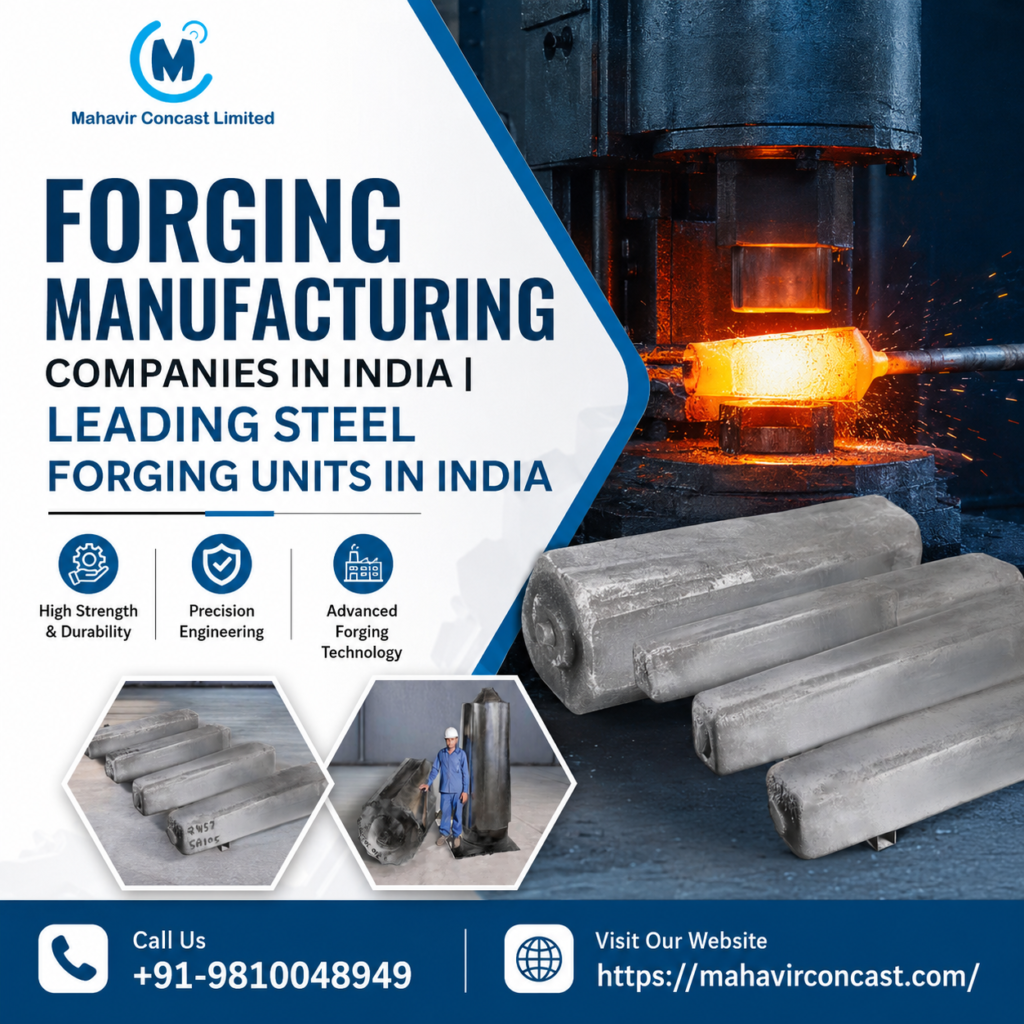
Every forged component from a crankshaft to a heavy industrial flange begins its life as an ingot. The quality of that starting material determines everything downstream: how well the steel forges, how uniform its grain structure becomes, and ultimately, how reliably the finished part performs under stress. This is why forging manufacturers across India rely on specialized ingot producers rather than treating raw steel as a commodity.
<cite index=”1-1″>Mahavir Concast manufactures forging quality ingots for some of the leading steel forging units in India, supported by an in-house vacuum degassing facility that ensures consistent, high-quality output. </cite> Here’s why that combination of specialization and process control matters.
The Role of Vacuum Degassing
Raw molten steel naturally contains dissolved gases primarily hydrogen, oxygen, and nitrogen that, if left untreated, can cause porosity, internal cracks, and brittleness in the final forged product. Vacuum degassing removes these impurities before the steel solidifies into an ingot, resulting in:
- Reduced hydrogen embrittlement risk, which is critical for large, forged components subject to sudden failure under load.
- Improved internal soundness, minimizing voids and inclusions that weaken the material.
- More consistent mechanical properties across the ingot, so forgers can predict how the material will behave during shaping and heat treatment.
For industries where forged components carry heavy structural or rotational loads, this level of process control isn’t optional it’s foundational.
A Wide Range of Grades for Every Application
<cite index=”1-1″>Mahavir Concast’s forging ingot range spans plain and alloy steels as well as stainless steel</cite>, giving forging units the flexibility to match material chemistry to the demands of the finished part:
Plain & Alloy Steel grades include familiar international specifications such as EN-8, EN-9, EN-15, EN-24, EN-19, SAE-4140, SAE-4340, SAE-8620, SA-105, C-45, and specialized chromium-nickel and chromium-molybdenum alloys like 34 Cr Ni Mo 6 and 42 Cr Mo 4 each offering a different balance of hardness, toughness, and machinability.
Stainless Steel grades are tightly controlled on carbon, manganese, silicon, sulphur, phosphorus, and chromium content, making them suitable for applications where corrosion resistance is as important as mechanical strength.
Built for Large-Scale Forging
Scale matters as much as chemistry. <cite index=”1-1″>Mahavir Concast’s forging ingots are available up to 38 x 44 inches, with a maximum weight capacity of 15,000 kilograms</cite> — sizing that supports the large, heavy-section forgings used in cement plants, mining equipment, power generation machinery, and other heavy industrial applications.
Why It Matters for Forging Units
For forging companies, the ingot supplier is effectively a partner in quality, not just a raw material vendor. A well-degassed, chemically consistent ingot:
- Reduces forging defects and rework, saving time and cost on the shop floor.
- Improves yield, since fewer ingots are rejected for internal flaws.
- Supports tighter tolerances in downstream machining and heat treatment.
A Trusted Name Since 2007
Operating with ISO 9001 and ISO 14001 certifications, Mahavir Concast has built a reputation among India’s forging industry for consistent, high-quality ingot supply — backed by rigorous melting, degassing, and quality control processes at every stage of production.
FAQs based on Mahavir Concast’s forging ingots:
What is a forging ingot?
A forging ingot is a solid block of cast steel used as the raw starting material for forging. It’s shaped, heated, and hammered or pressed into a finished component with a refined internal grain structure.
Why is vacuum degassing important for forging ingots?
Vacuum degassing removes dissolved gases like hydrogen, oxygen, and nitrogen from molten steel before it solidifies. This reduces porosity and hydrogen embrittlement risk, resulting in a stronger, more reliable ingot for forging.
What grades of forging ingots does Mahavir Concast manufacture?
Mahavir Concast produces both Plain & Alloy Steel grades (including EN-8, EN-9, EN-24, SAE-4140, SAE-4340, SAE-8620, and more) and Stainless Steel grades, giving forging units flexibility to match material properties to their application.
What is the maximum size and weight of ingots available?
Mahavir Concast manufactures forging ingots up to 38 x 44 inches, with a maximum weight capacity of 15,000 kilograms — suitable for large, heavy-section forgings used in cement, mining, and power generation industries.
How do I get in touch to order forging ingots?
You can reach Mahavir Concast at +91-9810048949, email info@mahavirconcast.com, or visit mahavirconcast.com/forging-ingots for more details on grades and specifications.