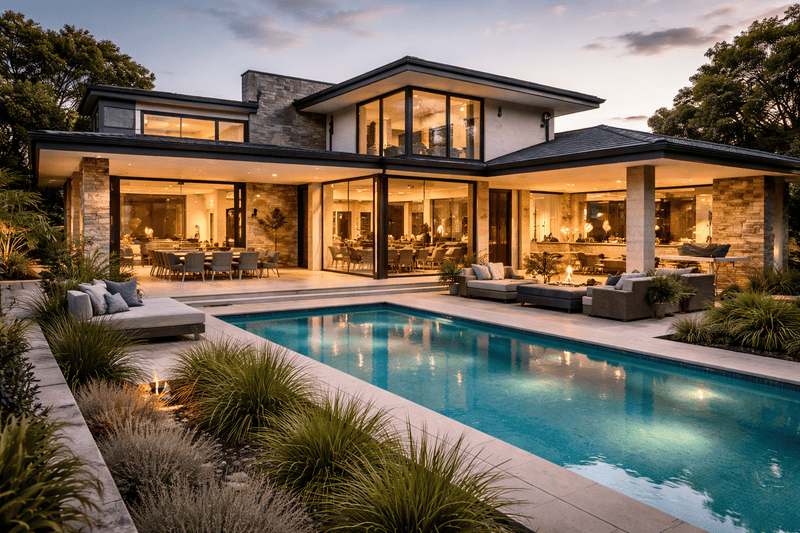
Luxury Home Design Melbourne continues to evolve as homeowners place greater emphasis on individuality, long-term liveability, and architectural clarity rather than surface-level opulence. In Melbourne, residential design responds to a unique combination of climate, planning controls, neighbourhood character, and lifestyle expectations. Luxury, in this context, is rarely about excess. Instead, it reflects precision, proportion, and the careful integration of form and function.
Across inner-city suburbs, bayside areas, and expanding metropolitan corridors, high-end homes are increasingly defined by how well they respond to site conditions and the people who live within them. A considered design approach allows homes to feel calm, intuitive, and enduring rather than trend-driven or overstated.
What defines luxury in Melbourne home design today
Luxury home design in Melbourne is shaped by restraint and intent. Clean architectural lines, thoughtful spatial planning, and material choices that age well are prioritised over decorative excess. Homes are designed to feel cohesive from the street through to private living spaces, with every element contributing to a unified whole.
Rather than focusing solely on visual impact, luxury homes are assessed by how they perform over time. Natural light, ventilation, acoustic comfort, and thermal efficiency play a major role in shaping daily experience. A well-designed home supports different stages of life without requiring constant adaptation.
In this sense, Luxury Home Design Melbourne reflects a broader shift towards homes that feel deeply personal while remaining practical and robust.
Responding to Melbourne’s architectural diversity
One of the defining characteristics of Melbourne’s residential landscape is its architectural diversity. Heritage homes sit alongside contemporary builds, and new developments often need to respect established streetscapes. Designing a luxury home within this context requires sensitivity to surrounding structures and planning overlays.
Designers must consider setbacks, height restrictions, overlooking controls, and neighbourhood character guidelines. A successful outcome balances individuality with contextual awareness, ensuring the home feels appropriate rather than imposing.
For those researching luxury home design options, this balance between expression and compliance is often a key consideration.
The role of customisation in high-end homes
Customisation is central to luxury residential design. Rather than adapting standard plans, high-end homes are shaped around how occupants live, work, and relax. This process begins with understanding routines, priorities, and long-term needs.
Spaces may be designed to support working from home, multigenerational living, or seamless indoor-outdoor connections. Storage is often integrated discreetly, ensuring functionality without visual clutter. Circulation between rooms is planned to feel natural rather than forced.
This level of detail distinguishes bespoke homes from volume builds, allowing each space to serve a clear purpose within the overall design.
Material selection and longevity
Material choices play a defining role in luxury home outcomes. In Melbourne, designers often favour materials that respond well to the local climate while offering longevity and tactile appeal. Natural stone, timber, concrete, and high-quality metal finishes are commonly used to create depth and texture.
Rather than following short-term trends, luxury homes focus on materials that age gracefully. Patina and subtle wear are embraced as part of the home’s character rather than viewed as flaws.
This emphasis on durability aligns with a growing preference for sustainable design principles, where quality replaces excess and long-term performance outweighs novelty.
Indoor–outdoor integration
Melbourne’s lifestyle encourages a strong connection between indoor and outdoor living. Luxury homes often blur the boundaries between these spaces through large openings, level thresholds, and consistent material palettes.
Courtyards, terraces, and landscaped gardens are designed as extensions of internal living areas rather than afterthoughts. Orientation plays a critical role, with north-facing spaces maximising natural light and solar access while protecting against harsh summer heat.
Effective indoor–outdoor integration enhances liveability and contributes to a sense of openness, even on constrained urban sites.
Planning and documentation as design foundations
Behind every refined luxury home is a detailed planning and documentation process. Accurate drawings, specifications, and coordination between consultants are essential to translating design intent into built form.
This stage ensures that proportions, alignments, and construction details are resolved before building begins. It also helps manage costs and reduces the likelihood of changes during construction.
Those exploring Melbourne home design services often underestimate the importance of this phase, yet it is fundamental to achieving consistent, high-quality outcomes.
Adapting luxury design to different Melbourne locations
Luxury Home Design Melbourne varies significantly depending on location. Bayside homes may prioritise views, privacy, and coastal resilience. Inner-city residences often focus on light capture, spatial efficiency, and heritage integration. Suburban and semi-rural properties may emphasise scale, landscape connection, and long sightlines.
Design responses are shaped by site orientation, lot size, and surrounding context. A luxury home in one area may feel entirely inappropriate in another if these factors are ignored.
Understanding local conditions allows designers to create homes that feel grounded rather than generic.
Technology and comfort without intrusion
Smart home technology is increasingly incorporated into luxury residences, but the emphasis is on seamless integration rather than visible complexity. Lighting, climate control, security, and audio systems are designed to operate intuitively without dominating the space.
Technology supports comfort and efficiency while remaining discreet. This approach ensures that homes feel calm and human-centred rather than overly automated.
As expectations evolve, technology becomes a supporting element rather than the focal point of luxury design.
Sustainability as a design principle
Sustainability is no longer separate from luxury. High-end homes increasingly incorporate passive design principles, energy-efficient systems, and responsible material choices.
Orientation, insulation, glazing, and shading strategies reduce reliance on mechanical heating and cooling. Water management and landscaping choices further support environmental performance.
Luxury, in this sense, reflects a commitment to thoughtful resource use alongside refined aesthetics.
The value of collaborative design processes
Successful luxury homes are rarely the result of a single viewpoint. Collaboration between designers, builders, engineers, and clients allows ideas to be tested and refined.
Open communication ensures that design intent is preserved while responding to technical and budgetary considerations. This process supports informed decision-making and helps maintain alignment throughout the project lifecycle.
For broader perspectives on residential planning and construction, homeowners often consult industry commentary such as the design and property insights available through home improvement articles and residential design resources, which explore how planning decisions influence long-term outcomes.
Luxury homes as long-term assets
A well-designed luxury home is not only a personal sanctuary but also a long-term asset. Thoughtful planning, durable materials, and adaptable layouts contribute to enduring value.
Rather than chasing short-lived design statements, Luxury Home Design Melbourne increasingly focuses on homes that remain relevant and functional for decades. This approach supports both lifestyle satisfaction and property resilience in a changing market.
Those considering custom home design options are often drawn to this balance of personal expression and enduring quality.
Designing with intent and restraint
Luxury in residential design is ultimately about clarity. Spaces that feel intentional, well-proportioned, and responsive to their occupants stand apart from those driven by surface detail alone.
In Melbourne’s dynamic housing environment, luxury homes succeed when they respect context, prioritise comfort, and embrace longevity. By focusing on how spaces are experienced rather than how they are marketed, designers create homes that feel authentic and quietly refined.