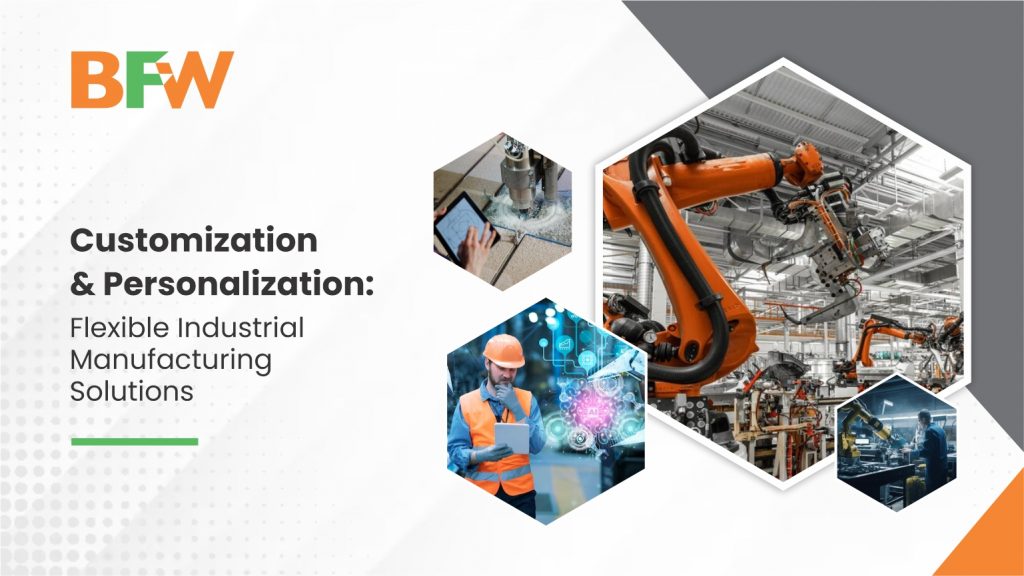
In today’s rapidly evolving industrial landscape, the demand for personalized and customized products is growing at an unprecedented pace. Modern consumers no longer settle for one-size-fits-all solutions they seek products tailored to their specific needs, preferences, and applications. This fundamental shift in consumer behavior is pushing manufacturers to rethink traditional production models and adopt flexible manufacturing solutions that can support customization without sacrificing efficiency, quality, or scale.
Driven by advancements in automation, robotics, machine learning, data analytics, and digital twin technologies, industrial manufacturing is undergoing a transformation. These innovations are enabling manufacturers to move beyond rigid production lines and embrace adaptive systems that deliver both personalization and productivity. In this blog, we explore the importance of customization and personalization in industrial manufacturing and examine how flexible solutions are shaping the future of the industry.
The Rise of Customization, Personalization, and Flexibility in Manufacturing
Traditional manufacturing systems were primarily designed for mass production. Fixed layouts, standardized processes, and long production runs made it difficult to introduce variations without significant cost or time penalties. As a result, manufacturers often struggled with longer lead times, excess inventory, and limited responsiveness to changing customer requirements.
While mass production offered economies of scale, it lacked the agility required to address diverse and evolving market demands. Any change in product design or configuration required extensive retooling, making customization impractical for many manufacturers.
However, as consumer expectations evolved and competition intensified, customization emerged as a key differentiator. Industries ranging from automotive and aerospace to electronics and industrial equipment began demanding greater flexibility. Customers increasingly wanted products that reflected their unique functional needs, performance expectations, and aesthetic preferences. This shift marked the beginning of a new manufacturing paradigm one centered on flexibility, personalization, and responsiveness.
Key Features of Flexible, Customized, and Personalized Manufacturing
Modern flexible manufacturing systems are built on a foundation of advanced technologies and intelligent processes that enable seamless customization. Some of the key features include:
Advanced robotics and automation:
Robotics and automation play a central role in enabling precise and repeatable customization. Automated systems can quickly adapt to different product configurations, reduce human error, and ensure consistent quality. Robots equipped with sensors and vision systems can handle complex tasks while maintaining high levels of accuracy and efficiency.
Data-driven decision-making:
The integration of data analytics and artificial intelligence allows manufacturers to gain deep insights into customer preferences, market trends, and production performance. Real-time data enables informed decision-making, helping manufacturers adjust designs, production schedules, and inventory levels to meet specific customer requirements.
Modular production lines:
Flexible manufacturing systems often rely on modular production units that can be easily reconfigured. This modular approach allows manufacturers to switch between product variants with minimal downtime, improving agility and reducing changeover costs.
Collaborative manufacturing:
Human–machine collaboration is a defining feature of modern manufacturing. While machines handle repetitive, high-precision tasks, skilled workers focus on problem-solving, innovation, and quality assurance. This synergy enhances productivity while maintaining flexibility.
Benefits of Customization and Personalization in Manufacturing
The shift toward flexible manufacturing offers several strategic advantages:
Increased customer satisfaction:
Customized products are better aligned with individual customer needs, leading to higher satisfaction, stronger brand loyalty, and long-term relationships.
Reduced costs and inventory:
On-demand production reduces the need for large inventories of standardized products. Manufacturers can produce exactly what is needed, minimizing storage costs and waste.
Market differentiation:
Customization enables manufacturers to stand out in competitive markets. Offering tailored solutions creates a unique value proposition that is difficult for competitors to replicate.
Adaptability to market trends:
Flexible manufacturing systems allow companies to respond quickly to changing market conditions, regulatory requirements, and technological advancements, ensuring long-term competitiveness.
Crucial Factors for Implementing Flexible Manufacturing
Successfully adopting flexible manufacturing requires a strategic focus on several key factors:
Agility:
Agility is essential for customization. Manufacturers must be able to rapidly modify production schedules, adjust product configurations, and respond to shifting customer demands. Agile systems enable faster time-to-market while maintaining quality and efficiency.
Innovation and technology:
Advanced technologies are the backbone of flexibility. Real-time data analytics, automation, artificial intelligence, and predictive analytics help manufacturers anticipate demand, optimize workflows, and reduce lead times. These technologies also support continuous improvement and innovation.
Lean tools and principles:
Lean manufacturing emphasizes waste reduction, efficiency, and customer value. By implementing lean tools, manufacturers can streamline processes, improve quality, and enhance responsiveness critical elements for successful customization.
The Ultimate Goal: Lot Size of One
The ultimate objective of a Flexible Manufacturing System is the ability to produce any product in a “lot size of one” on a mass manufacturing platform. Achieving this capability means manufacturers can deliver fully customized products while maintaining the speed, quality, and cost advantages of mass production.
Producing in a lot size of one allows companies to meet stringent hygiene parameters such as reduced lead time, consistent quality, and operational efficiency while still offering the desired level of customization. It represents the pinnacle of manufacturing flexibility.
BFW, a leading machine tool manufacturer, is proud to have achieved this capability to a significant extent at its new manufacturing facility in Thally. By leveraging advanced technologies, agile processes, and lean principles, BFW demonstrates how flexible manufacturing can successfully bridge the gap between mass production and personalized solutions setting a benchmark for the future of industrial manufacturing.