Key Takeaways
-
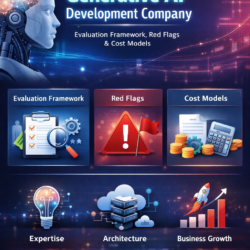
Building a successful generative AI solution requires careful planning, robust architecture, and the right model selection.
-
Partnering with a trusted generative AI development company ensures smooth deployment and scalability.
-
Production-ready AI solutions demand attention to data strategy, system integration, and operational monitoring.
-
Clear alignment between AI capabilities and business objectives ensures measurable impact.
Artificial intelligence is no longer a futuristic concept. Businesses across sectors are increasingly looking to leverage AI to automate processes, generate insights, and create smarter experiences for their customers. Yet, the journey from concept to production-ready AI solutions is riddled with challenges. Many organizations struggle because they underestimate the complexity involved in building a functional generative AI system. Without proper planning, model selection, and deployment strategies, even the most promising AI initiatives can fail to deliver tangible business outcomes.
This is where partnering with a reliable generative AI development company becomes crucial. Companies like Appinventiv specialize in guiding enterprises through every stage of AI solution development—from architecture design to model selection and production deployment. Choosing the right partner ensures that your AI investments translate into operational efficiency, improved customer experiences, and measurable ROI.
Understanding the Business Pain
Organizations often embark on AI projects with high expectations but face practical roadblocks during execution. Common challenges include: inconsistent data quality, difficulty integrating AI models into existing systems, and lack of scalability. These issues can lead to delayed deployments, increased costs, and, in some cases, abandonment of AI initiatives altogether.
Enterprises need a structured approach that not only addresses technical requirements but also aligns AI capabilities with strategic objectives. A generative AI development company can bridge this gap, providing the expertise and guidance needed to convert AI concepts into production-ready solutions that deliver tangible business outcomes.
Industry Reality: Why AI Success Requires Expertise
The AI landscape is evolving rapidly, and generative AI solutions have become a key driver of innovation. From automated content generation to intelligent virtual assistants, these systems offer unprecedented capabilities. However, building a robust AI solution is more than training a model. It requires a combination of:
-
Data management – collecting, cleaning, and organizing high-quality data.
-
Model selection – choosing architectures that fit the business problem.
-
Scalable deployment – ensuring the solution works reliably in production environments.
Many businesses underestimate these requirements, which can result in AI systems that are difficult to maintain, lack integration, or fail to deliver expected outcomes. Partnering with experienced developers ensures these challenges are addressed early, saving time and costs while maximizing AI performance.
Designing the Right Architecture
Architecture is the backbone of any successful AI solution. A poorly structured system can lead to performance bottlenecks, integration issues, and scalability problems. Effective architecture focuses on modularity, flexibility, and maintainability.
For generative AI, architecture must account for several critical components:
-
Data pipelines – seamless collection, preprocessing, and transformation of raw data.
-
Model layer – the AI algorithms, trained and fine-tuned to meet the specific business requirements.
-
Deployment layer – APIs, cloud infrastructure, and integration with enterprise software.
-
Monitoring and optimization – tracking model performance, handling errors, and updating models as needed.
A company like Appinventiv emphasizes creating scalable architectures that can adapt to evolving business needs. By planning for future growth and ensuring robust integration with existing systems, enterprises can avoid costly rework and ensure smooth AI adoption.
Model Selection: Aligning AI Capabilities with Business Goals
Choosing the right AI model is critical to achieving desired outcomes. Generative AI models vary in size, complexity, and capabilities. Factors to consider during selection include:
-
Nature of the task – whether the AI is generating text, images, or predictions.
-
Data availability – the volume and quality of data available to train the model.
-
Scalability – how well the model can adapt to increasing demand.
-
Latency and performance – the speed and efficiency of the model in real-world applications.
A proficient generative AI development company will assess your requirements and recommend models that align with your business objectives. The right model ensures the AI solution not only functions correctly but also delivers measurable benefits, whether in improved decision-making, customer engagement, or operational efficiency.
Production Deployment: From Lab to Real-World Impact
Deployment is often the most challenging phase of AI development. Many organizations experience a “proof-of-concept gap,” where models work in controlled environments but fail to scale in production. Successful deployment requires:
-
Infrastructure readiness – cloud or on-premises setup capable of handling AI workloads.
-
Integration with existing systems – seamless APIs and compatibility with enterprise software.
-
Monitoring and maintenance – real-time performance tracking and model retraining.
-
Security and compliance – protecting sensitive data and adhering to regulations.
By working with an experienced partner, enterprises can navigate these complexities efficiently. Appinventiv’s approach focuses on delivering production-ready AI systems that operate reliably at scale, ensuring business continuity and maximizing ROI.
Mapping AI Services to Business Outcomes
A generative AI solution should solve real business problems, not just demonstrate technical prowess. By mapping AI services to strategic goals, organizations can ensure tangible outcomes. Examples include:
-
Automated content generation – reducing operational costs and accelerating workflows.
-
Intelligent virtual assistants – improving customer support and engagement.
-
Predictive analytics – enhancing decision-making and forecasting capabilities.
This business-aligned approach ensures AI delivers measurable value rather than existing as an isolated technology.
Cost Considerations for AI Solutions
Understanding the financial aspect of AI development is essential. Generative AI projects involve various costs, including:
-
Model development and fine-tuning
-
Infrastructure and deployment
-
Monitoring, maintenance, and updates
-
Expertise and team composition
Common pricing models include fixed-price, time-and-material, and hybrid models. Transparent discussion of costs ensures enterprises can plan budgets accurately and avoid surprises during deployment.
Why Choose Appinventiv as Your AI Partner
Appinventiv is a trusted generative AI development company that specializes in building end-to-end AI solutions. With expertise spanning architecture design, model selection, and production deployment, Appinventiv ensures AI projects are delivered efficiently and effectively. Their solutions are scalable, secure, and aligned with business objectives, helping enterprises extract measurable value from their AI investments.
Frequently Asked Questions (FAQs)
Q1: What is the role of a generative AI development company?
A: Such a company guides enterprises through AI solution design, model selection, deployment, and ongoing optimization, ensuring solutions are production-ready and business-focused.
Q2: How do I choose the right AI model for my business?
A: The choice depends on the task, available data, scalability needs, and performance requirements. An experienced development partner can recommend models that align with your objectives.
Q3: How long does it take to build a generative AI solution?
A: Typically, enterprise-grade solutions take 3–6 months from planning to deployment, depending on complexity and scope.
Q4: Can AI solutions be integrated with existing systems?
A: Yes, integration is a core aspect of enterprise AI. Proper architecture ensures smooth connectivity with software, databases, and workflows.
Q5: How can enterprises ensure AI projects deliver ROI?
A: By aligning AI solutions with business goals, choosing the right models, designing scalable architectures, and working with experienced development partners.